
What is an EOS Accountability Chart and Free EOS Template
Use our free role and EOS accountability chart template and learn how this will improve your business. If you have ever watched a task fall through the cracks because two people each assumed the other was handling it, you have already experienced the exact problem the EOS Accountability Chart was built to solve. Role confusion is one of the most common and most expensive problems in small and mid-sized businesses. People step on each other. Decisions stall. Projects drift. The EOS Accountability Chart is the antidote.
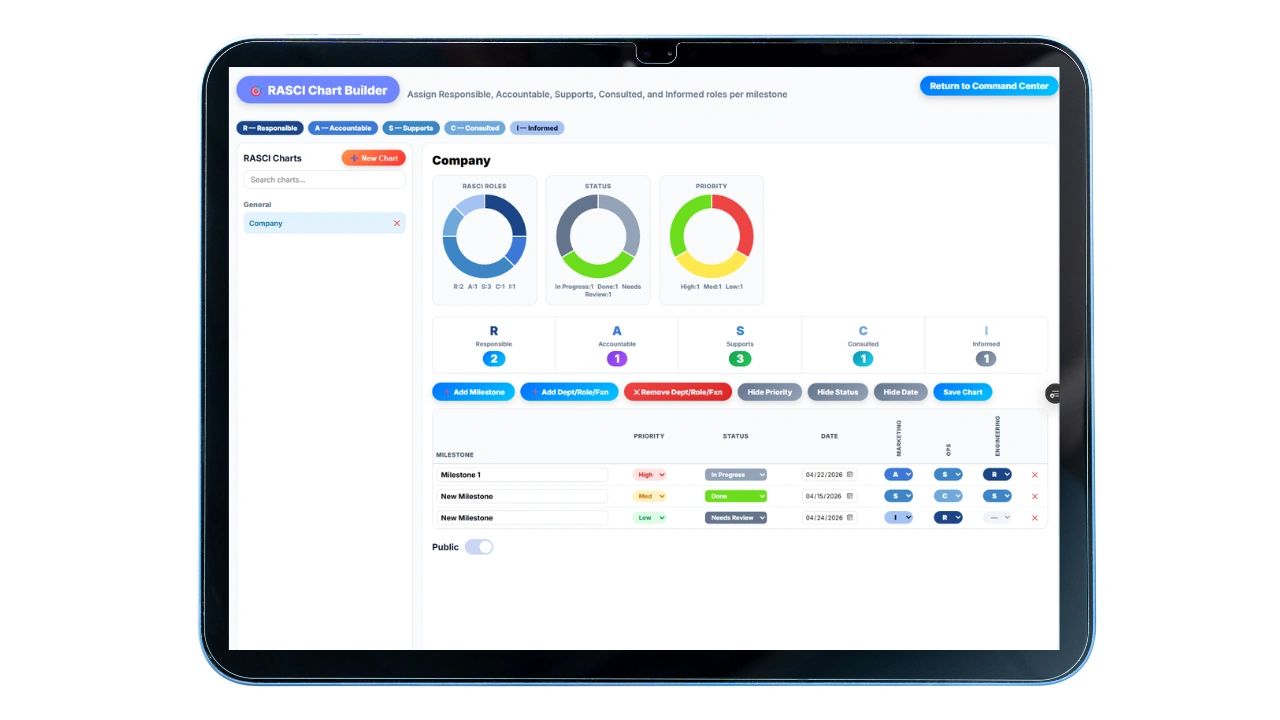
This post breaks down what the EOS Accountability Chart is, how it differs from a traditional org chart, how to build one, common mistakes to avoid, and how tools like the Updoot RASCI chart builder can help you take accountability even further once the foundation is in place.
What Is an EOS Accountability Chart?
The EOS Accountability Chart is a core tool inside the Entrepreneurial Operating System, a business management framework created by Gino Wickman and detailed in his book Traction. The chart is part of the People Component of the EOS Model and is designed to give every business a clear visual map of who owns what.
Unlike a traditional org chart that shows reporting lines and job titles, the Accountability Chart is built around functions and seats. A seat is a role defined by what the business needs, not by who currently fills it. Each seat comes with a clear list of five or fewer core roles, and each of those roles has specific responsibilities attached to it.
The foundational principle is structure first, people second. You design the chart around what the business needs to succeed over the next six to twelve months. Then and only then do you ask whether the right people are sitting in the right seats.
How Is EOS Accountability Different from an Org Chart?
Most org charts are little more than a visual directory. They show who reports to whom and what everyone's title is. They tell you almost nothing about who is actually accountable for outcomes.
The Accountability Chart flips this. It starts with functions, not people. Every business, regardless of industry, has to sell something, deliver something, and manage its finances. Those three core functions sit at the top of the chart. Everything else flows from them.
Where an org chart might show a box labeled "VP of Strategy and Special Projects" with no clear indication of what that person actually does, an Accountability Chart would define the specific outcomes that seat is responsible for delivering. The difference sounds subtle but in practice it is enormous. When something goes wrong, the Accountability Chart tells you immediately who owns it. When a decision needs to be made, everyone already knows who makes the call.
One of the most important rules in the EOS framework is that each seat has exactly one owner. Two names in one box equals no accountability. When two people share ownership of a function, neither person truly owns it.
Why Most Small Businesses Struggle Without Accountability in a Chart
Growing businesses often hit what EOS practitioners call the ceiling. The founder is wearing every hat. Roles overlap. Communication breaks down. People are performing at a high level individually but the organization is not performing as a whole.
The root cause is almost always structural. Without a clear accountability structure, the business runs on assumptions. People assume someone else is handling the customer complaint. Two managers assume they both have authority to approve the vendor contract. A salesperson has no idea whether operations can fulfill what they just promised a client.
The Accountability Chart forces the leadership team to have difficult conversations about who actually owns what. It removes ambiguity. It reduces political tension by making ownership a function of role design rather than personality or tenure. And it gives every employee a clear picture of where they fit and what success looks like in their seat.
How to Build an EOS Accountability Chart
Start with the three major functions. Every Accountability Chart begins with the same three departments at the top level: Sales and Marketing, Operations, and Finance and Administration. These sit under the leadership structure, which typically includes a Visionary and an Integrator at the top.
Define the seats your business needs. Do not start by writing your current employees' names in boxes. Start by listing every function the business needs to operate and grow over the next year. Some of these may not have a person assigned to them yet. That is fine. The chart should reflect reality as it needs to be, not necessarily as it is today.
Assign five or fewer roles per seat. Each seat should have a short list of the roles that make up the core of that position. If you find yourself listing ten or twelve items, you are cramming too much into one seat. Either break the seat into two or trim down to the most critical accountabilities.
Add responsibilities to each role. Roles are the high-level functions. Responsibilities are the specific deliverables and outcomes tied to each role. This level of detail is what makes the chart useful day to day rather than something that hangs on the wall and collects dust.
Assign one name to each seat. Once the structure is defined, go through each seat and identify who currently fills it. Some people may sit in multiple seats, especially in smaller companies. That is acceptable as a temporary state but the goal is to get to one person per seat as the business grows.
Share it with the entire team. The Accountability Chart only works when everyone can see it. Transparency is the point. When your whole team understands who owns what, it reduces the time spent tracking down the right person and increases the speed of decision making across the organization.
Review it quarterly. The chart should evolve as the business grows. A structure that works at ten employees will not work at fifty. Set a rhythm of reviewing the chart at least once per quarter during planning sessions.
Common Mistakes to Avoid With an EOS Accountability Chart
Designing around people rather than structure is the most common mistake. It is tempting to build seats that match your current team, but this locks you into today's limitations and often creates roles that exist to protect feelings rather than drive results.
Allowing shared ownership is another frequent error. If two people both feel accountable for a function, neither person will treat it as truly theirs. One owner per seat, always.
Building the chart once and never updating it defeats the purpose. The organizational structure needs to keep pace with the growth of the business. A chart built at the early stage of a company will become a liability if it is not updated as new functions emerge and the team expands.
Finally, confusing titles with seats is a trap many leadership teams fall into. The chart is not about status or hierarchy. It is about functions and outcomes. A seat titled Head of Customer Experience is far more useful than a seat titled Senior Director because it makes the accountability obvious.
Taking Accountability Further with the Updoot RASCI Chart Builder
The EOS Accountability Chart gives you clarity on who owns what at the structural level. But once your organization is executing on projects, initiatives, and milestones, you need a way to map accountability at the task level as well. That is where a RASCI chart comes in.
RASCI stands for Responsible, Accountable, Supports, Consulted, and Informed. It is a project-level accountability framework that defines who does the work, who owns the outcome, who helps, who needs to be asked before decisions are made, and who simply needs to be kept in the loop.
Updoot includes a built-in RASCI chart builder designed specifically for small and mid-sized businesses running inside platforms like EOS. You can build a RASCI chart for any project or initiative, assign your team to each column, and give everyone on the team visibility into exactly where they fit. Milestones can be tracked with priority levels, status updates, and due dates. The charts live inside your Updoot workspace alongside your other business tools so nothing is scattered across separate files or inboxes.
The combination of an EOS Accountability Chart at the organizational level and a RASCI chart at the project level gives your team complete clarity from the top of the business down to the individual task. No gaps. No duplicated effort. No dropped balls.
You can learn more and get started at xecutethevision.com.
When to Use the EOS Accountability Chart
The Accountability Chart is the right tool at any stage but it becomes critical the moment a business moves beyond a solo operator or a very small team. As soon as you have more than five or six people, role confusion starts. As soon as you have more than one layer of leadership, accountability gaps start to appear.
If your business is running on EOS, the Accountability Chart is a non-negotiable starting point. If you are not running EOS but want clearer structure, you can still build an accountability chart using the same principles. Start with functions, not people. Define seats by outcomes, not titles. Assign one owner to each seat. Review and update regularly.
The businesses that get this right build a foundation that supports everything else: hiring, goal setting, performance management, delegation, and growth. The businesses that skip it spend their energy managing confusion instead of driving results.
EOS Accountability Chart Template to Copy Paste
COMPANY NAME EOS Accountability Chart
VISIONARY
Name:
Roles:
1.
2.
3.
4.
5.
INTEGRATOR
Name:
Roles:
1.
2.
3.
4.
5.
SALES AND MARKETING
Name:
Roles:
1.
2.
3.
4.
5.
OPERATIONS
Name:
Roles:
1.
2.
3.
4.
5.
FINANCE AND ADMINISTRATIONName:
Roles:
1.
2.
3.
4.
5.
SALES AND MARKETING SEATS
Name:
Roles:
1.
2.
3.
4.
5.
OPERATIONS SEATS
Name:
Roles:
1.
2.
3.
4.
5.
FINANCE AND ADMINISTRATION SEATS
Name:
Roles:
1.
2.
3.
4.
5.
Frequently Asked Questions
What is an EOS Accountability Chart? It is a structural tool that defines who owns what in a business by organizing the company into seats based on functions and outcomes rather than titles or hierarchy. It replaces vague org charts with clear ownership at every level.
What are the three main departments in an EOS Accountability Chart? Every Accountability Chart starts with Sales and Marketing, Operations, and Finance and Administration sitting under a leadership structure that typically includes a Visionary and an Integrator at the top.
How many roles should each seat have in an Accountability Chart? Each seat should have five or fewer roles. If you find yourself listing ten or twelve items, the seat needs to be split into two or trimmed down to the most critical accountabilities.
Can one person hold multiple seats in an EOS Accountability Chart? Yes, especially in smaller companies. It is acceptable as a temporary state but the goal is to get to one person per seat as the business grows.
What is the difference between an EOS Accountability Chart and a RASCI chart? The Accountability Chart defines ownership at the organizational level. A RASCI chart maps accountability at the project and task level, defining who does the work, who owns the outcome, who helps, who gets consulted, and who stays informed.
How often should an EOS Accountability Chart be reviewed? At least once per quarter during planning sessions. A structure that works at ten employees will not work at fifty, so the chart needs to evolve as the business grows.
The Bottom Line
The EOS Accountability Chart is one of the simplest and most powerful tools available to small business leaders. It replaces vague org charts with clear ownership. It forces honest conversations about who is doing what and whether the right people are in the right seats. It creates the structural clarity that every growing business needs to scale without chaos.
Pair it with project-level accountability tools like the Updoot RASCI chart builder and you have a complete system for making sure the right work is being done by the right people at every level of the organization. That combination is what separates businesses that grow with intention from businesses that grow with frustration.
Find more free templates here
Weekly and biweekly meeting agenda template
Level 10 meeting agenda template