
The Accidental Diminisher: A Summary of Multipliers
.png)
Do you multiply or diminish?
Prior to a month ago, I would not feel confident in answering that question, but I assure you it’s a good one. The authors of the book, Multipliers claim that if you’re a Diminisher, you get about half of what you could from people, and if you’re a Multiplier, you get almost double the results. If you’re unsure of what that means or how to answer, I recommend checking a book called Multipliers by Liz Wiseman and starting with the quiz at www.multipliersquiz.com.
Let me ask another way. How often would you find yourself saying this to yourself, “They will never figure this out without me?” What about “People are smart and will figure this out.”
Those two statements are the key differentiators this book discusses behind a Diminisher, who believes people will not figure things out without them, and a Multiplier, who believes in people being smart and figuring things out.
More about Diminishers
A Diminisher believes that intelligent people are very rare, and they think that they are the only ones who can come up with great ideas and get things done. They need to utilize people and their experiences more. They have a high focus on having control, and if they don’t, then the job won’t be done right. This is very similar to the term micromanager. The result is that other intelligence and capacity are not used by other employees and therefore are not productive as they could be, yielding poor results.
More about Multipliers
On the other hand, a Multiplier is viewed as a genius maker, as people around them end up smarter, fulfilled and further progress in their careers. More gets done with Multipliers because they use the intelligence of others, maximizing their potential. Sounds great, doesn’t it?
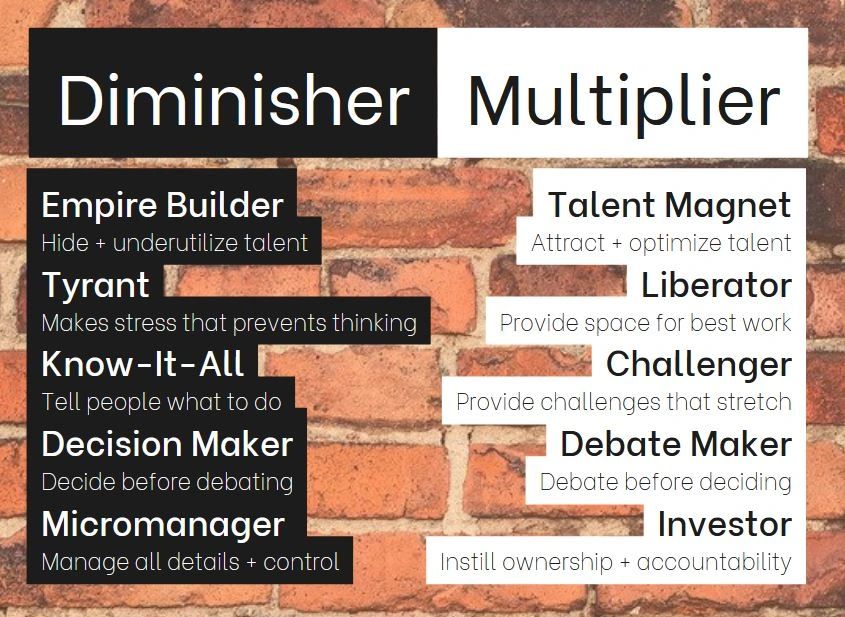
So how does this apply to you? All things equal, a Diminisher and Multiplier likely have the same job; it’s just that a Multiplier will distinguish itself with these 5 areas.
1. Multipliers attract and optimize talent
Multipliers do this so well that you will find people wanting to work for them because it’s proven that people will go far. On the other hand, you will find Diminishers leading in areas where careers have little to no growth.
2. Multipliers create intensity to draw out the best thinking
The fear is removed so that people can feel comfortable and safe therefore doing their best work. A Diminisher, on the other hand, will provide an environment where people feel judged.
3. Multipliers provide challenges
They will keep beyond what they know by planting opportunities, and setting up challenges, and people believe the challenge can be done. On the other hand, Diminishers will be the know-it-all, and it will be more of an opportunity for them to show off their knowledge.
4. Multipliers will debate decisions
Decisions are made after going back and forth with a debate. It’s common to see a Multiplier foster debate from the other side as well to ensure all perspectives are looked at. Diminishers, on the other hand, will try to sell their own and keep decisions generally behind closed doors.
5. Multipliers instill ownership and accountability
They set high expectations, motivating people to hold each other accountable. A Diminisher, on the other hand, will get into the fine details, keep the ownership, and directly manage along the way to get the results, also known as a micromanager.
The book explains that it’s not likely to cut and dry where you fall, but often there will be elements of both in each person. Not only can it be somewhat of a scale, but often, people are Accidental Diminishers. I took the quiz mentioned at the beginning of this article and scored 31. How does that stack up to you? Depending on your score, let’s say you are an Accidental Diminisher; this means you think they are being a great manager, not realizing what you are doing isn’t yielding the expected results. For example, page 208 in the book has a great chart that shows the behaviors of an Accidental Diminisher and how to overcome them.
Behaviors of an Accidental Diminisher
Idea fountain: These people hope that by providing constant ideas, people will be motivated, but it generally overwhelms people, and they will clam up or focus on new ideas, one after another.
Always on This is a tendency to constantly share their point of view, but in reality, this leaves no space for others, and eventually, people ignore them.
Rescuer: This is the behavior of someone attempting to jump in to make others successful in order to protect their reputation, but then people will depend on them too much, and it has the opposite effect.
Pacesetter: These people set high standards for quality or speed, but usually others can’t keep up with this, and they give up.
Rapid Responder: Quick moves are made always to keep the organization going, but this can cause a slowdown because there can be too many changes at once.
Optimist: This is seen in people who try to create the belief that the team can do it with extreme optimism, and people end up unsure if they understand the difficulty level and that it may fail.
Protector: Often seen when there is an attempt to keep people safe in other areas of the organization and political issues, but then people end up unable to stand on their own feet.
Strategist: This behavior is trying to paint a picture of the future, but people tend to question the boss instead of figuring out how they will get to the result.
Perfectionist: This person thinks if they make corrections so that it’s perfect, people will produce the best work possible; however, when people feel that criticism, it can make them stop trying.
If you find that you identify with these behaviors, there are ways to change with the five disciplines of Multipliers. Use this chart to get started.
Behaviors you can change
To become a Multiplier, try making these adjustments in your daily activity
- Ask hard questions that make people think rather than give the answer.
- Think about assisting people rather than taking over.
- Rather than taking full responsibility, give the team 51% of the vote.
- Don’t expect perfect; make room for mistakes to occur.
- Focus less on hiring specifically smart people and look for what is a natural genius in each of the team.
- Think about delegating as stretch challenges instead, where it’s taking small steps and gearing up for larger ones.
Example of a Diminisher vs Multiplier results
Issue: A newly designed product is needed, and the team told you they are not confident in the ask
Diminisher Example
Behavior: Jump in and take over, and suddenly, everything is back on track.
Reward: I feel great and needed because I was able to solve the problem.
Consequence: The team didn’t learn anything and won’t be able to solve problems in the future or take ownership.
Multiplier Example
Behavior: I ask the hard questions to get them thinking, contributing at a minimal level to remove roadblocks and suddenly they are back on track.
Reward: The team feels confident because they solved the problem.
Consequence: The team grows and not only trusts you to assist, but they feel psychologically safe.
In summary, I highly recommend you not only read the book but also take the quiz to understand where you may fall on the scale between a Diminisher and a Multiplier. From here, you can take this insight and start making small changes in behavior towards a Multiplier. I’m still going through the exercises myself but expect significant changes in the team, and I look forward to getting not only a lot more from people but seeing people flourish around me.
Written by Nicole Hullihen, July 30th, 2023