
Salary Bands Meaning and How to Build Them
.png)
If your company does not have salary bands, you are guessing on compensation.
And guessing leads to problems:
- Employees feel underpaid
- Managers make inconsistent offers
- Pay gaps develop
- Retention drops
Salary bands fix that.
They bring structure, fairness, and clarity to how you pay your team.
In this guide, you will learn:
- What salary bands are
- Why they matter
- How to create them step by step
- The pros and cons
- A ready-to-use salary band chart you can include or download
What Are Salary Bands?
Salary bands are defined ranges of pay for a specific role or level within a company.
Each band includes:
- A minimum salary
- A midpoint
- A maximum salary
Instead of paying people randomly, you create a structured range.
For example:
- Junior Role: $50,000 to $65,000
- Mid-Level Role: $65,000 to $85,000
- Senior Role: $85,000 to $110,000
This creates consistency.
Why Salary Bands Matter
Salary bands are not just about payroll.
They are about trust and scalability.
1. Fairness and Transparency
Employees want to know they are paid fairly.
Salary bands:
- Reduce bias
- Create consistency
- Improve trust
2. Better Hiring Decisions
Without bands:
- You risk overpaying or underpaying
With bands:
- You know your range before making an offer
3. Easier Promotions and Raises
Salary bands give you structure for:
- Pay increases
- Role progression
No more guessing what a raise should be.
4. Budget Control
You can forecast:
- Payroll growth
- Hiring costs
This is critical for scaling businesses.
5. Improved Retention
Employees leave when they feel:
- Underpaid
- Treated unfairly
Salary bands reduce both.
How Salary Bands Work
Each band typically includes three parts:
Minimum
The lowest salary for the role.
Used for:
- Entry-level hires
- Less experienced employees
Midpoint
The market rate.
Represents:
- Fully competent employees
- Expected performance level
Maximum
The upper limit.
Reserved for:
- Top performers
- Highly experienced employees
Types of Salary Band Structures
There are a few common approaches.
1. Traditional Bands
Clear levels:
- Junior
- Mid
- Senior
Simple and easy to manage.
2. Broad Bands
Wider ranges that cover multiple levels.
More flexibility but less structure.
3. Role-Based Bands
Each role has its own range.
More precise but requires more setup.
Step-by-Step: How to Create Salary Bands
Let’s make this practical.
Step 1: Define Roles and Levels
Start with:
- Job titles
- Seniority levels
Example:
- Marketing Coordinator
- Marketing Manager
- Director
Step 2: Research Market Data
Use:
- Salary surveys
- Job postings
- Industry benchmarks
You need to know:
- What the market pays
Step 3: Set Your Midpoints
This is your anchor.
Your midpoint should reflect:
- Market average
- Your company positioning
Step 4: Define Range Width
Typical ranges:
- 20% to 50% spread
Example:
- Midpoint: $80,000
- Range: $65,000 to $95,000
Step 5: Align with Business Strategy
Ask:
- Are you paying above market?
- At market?
- Below market with other perks?
Step 6: Document Everything
This is critical.
Define:
- How raises work
- When employees move within bands
- Promotion criteria
Step 7: Communicate Clearly
If you hide salary bands, you lose most of the benefit.
Transparency builds trust.
Pros of Salary Bands
Consistency
Everyone is evaluated using the same structure.
Scalability
You can grow without chaos.
Better Hiring
Clear ranges improve offer decisions.
Reduced Bias
Decisions are based on structure, not opinion.
Cons of Salary Bands
Let’s be honest.
Less Flexibility
Some candidates may expect more than your band allows.
Requires Maintenance
Markets change. You must update regularly.
Can Feel Restrictive
Top performers may feel capped if bands are tight.
Common Mistakes to Avoid
Avoid these and you will already be ahead.
Making Bands Too Narrow
You lose flexibility.
Not Updating Bands
Market changes quickly.
Ignoring Performance
Bands should not replace performance-based decisions.
Overcomplicating It
Keep it simple or no one will use it.
When Should You Implement Salary Bands?
You should create salary bands if:
- You are hiring regularly
- You have more than 5 to 10 employees
- You want consistency in pay
If you wait too long, fixing compensation later becomes messy.
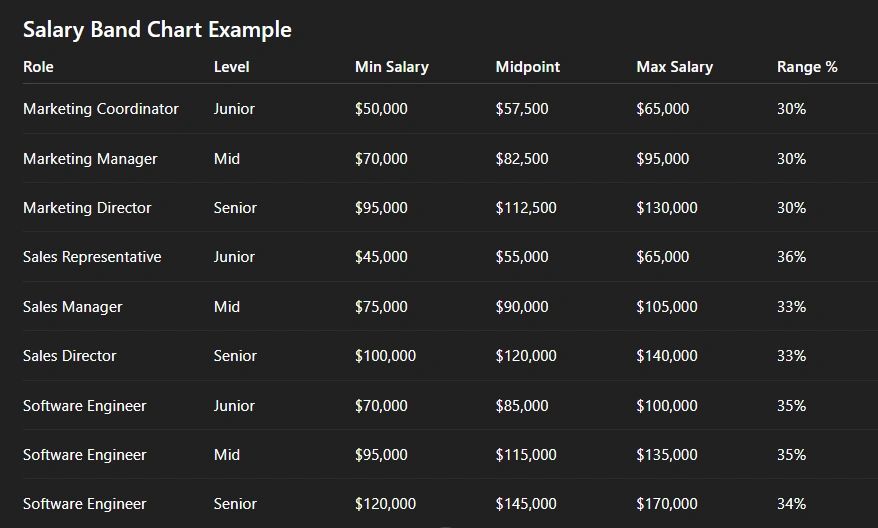
Salary Band Chart Example
How to Turn This Into an Excel or Google Sheets Tool
To make this more powerful:
Add columns for:
- Current employee salary
- Position in band (below, mid, above)
- Raise recommendation
- Promotion eligibility
This turns a simple chart into a decision-making tool.
Final Take
Salary bands are one of the simplest ways to bring structure to your business.
They help you:
- Pay fairly
- Hire smarter
- Retain better employees
- Scale without chaos
If you are serious about building a high-performing team, this is not optional.
Start simple.
Create your bands.
Refine them over time.
That is how you build a system that grows with your business.