
Overtime and Holiday Pay in the Same Week
.png)
Holiday pay seems straightforward until it lands in the same week as overtime. Then suddenly, business owners are asking:
“Do holiday hours count toward overtime?” “Do I have to pay overtime on top of holiday pay?”
This is where confusion leads to costly mistakes. And unlike PTO, holiday pay has its own nuances that make it worth understanding separately.
If you want to handle overtime and holiday pay in the same week correctly, this guide will walk you through the rules, real examples, and how to stay compliant without overpaying.
The Key Difference: Holiday Pay vs Overtime
Let’s start with the most important concept:
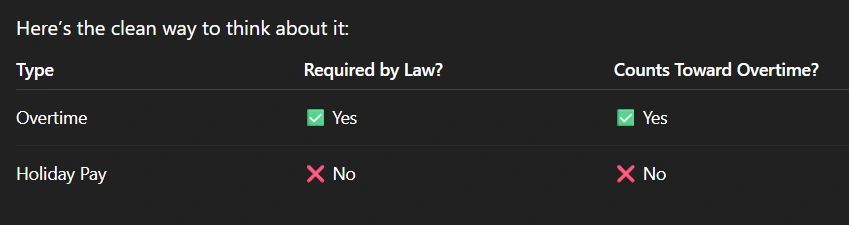
👉 Holiday pay is not legally required under federal or California law 👉 Overtime pay IS legally required
That means:
- Overtime rules are governed by law
- Holiday pay is determined by your company policy
But once you offer holiday pay, you need to understand how it interacts with overtime.
Do Holiday Hours Count Toward Overtime?
Here’s the rule:
👉 Holiday hours do NOT count as hours worked
This is the same principle as PTO but the reason matters more here.
Even if an employee is paid for a holiday:
- Those hours are not considered “worked” time
- They do not count toward 40 hours for overtime
Example #1: Holiday Pay + 40 Hours Worked
Scenario:
- Employee works 40 hours
- Receives 8 hours holiday pay
👉 Total paid = 48 hours 👉 Hours worked = 40
Result:
- Regular pay = 40 hours
- Holiday pay = 8 hours
- No overtime
Example #2: Holiday Pay + Overtime Worked
Scenario:
- Employee works 45 hours
- Receives 8 hours holiday pay
👉 Total paid = 53 hours 👉 Hours worked = 45
Result:
- Regular = 40 hours
- Overtime = 5 hours
- Holiday = 8 hours
👉 Overtime applies because actual worked hours exceeded 40—not because of holiday pay
Example #3: Working on the Holiday Itself
This is where things differ from PTO.
Scenario:
- Employee works 10 hours on a holiday
- No additional PTO or time off
Important:
Holiday pay is not required by law, but many companies offer:
- Time and a half
- Double time
- Or bonus pay
Legally Required:
- First 8 hours = regular pay
- Next 2 hours = overtime (if in California, daily OT applies)
👉 If your company policy says “holiday = time and a half,” that is separate from legal overtime
Example #4: Holiday + California Daily Overtime
Scenario:
- Monday (holiday): employee works 11 hours
- Rest of week: 8 hours/day (4 days)
Breakdown:
- Monday:
- 8 hours regular
- 3 hours overtime (over 8)
- Weekly total worked = 43 hours
Result:
- Daily overtime = 3 hours
- Weekly overtime = not added (already counted)
👉 Holiday status does NOT override California daily overtime law
Example #5: Holiday Breaks the 7th Day Rule
This is a key difference from working straight through a week.
Scenario:
- Employee works 6 days
- Holiday (paid, not worked) falls in between
👉 This breaks the consecutive workday streak
Result:
- 7th day overtime rule does NOT apply
👉 Because the employee did not actually work 7 consecutive days
The Big Mistake Employers Make
The most common (and expensive) error:
❌ Treating holiday pay like hours worked
This leads to:
- Paying overtime when it’s not required
- Inflated payroll costs
❌ Confusing company policy with legal requirements
Example:
- You offer “holiday = time and a half”
- That does NOT replace legal overtime rules
👉 You may owe BOTH depending on the situation
Holiday Pay Policy vs Overtime Law
California-Specific Considerations
If you’re in California, you must still follow:
1. Daily Overtime Rules
- Over 8 hours/day = overtime
- Over 12 hours/day = double time
Even on holidays.
2. Weekly Overtime Rules
- Over 40 hours worked = overtime
- Holiday hours do NOT count
3. 7th Consecutive Day Rule
- Only applies if employee actually works all 7 days
- Holidays (not worked) break the sequence
How to Handle This in Real Life
If you want to get this right without overthinking it:
Step 1:
Separate:
- Hours worked
- Holiday hours paid
Step 2:
Calculate overtime based ONLY on:
- Hours worked
Step 3:
Apply your company’s holiday policy separately
Step 4:
Never combine holiday hours into overtime calculations
Overtime and Holiday Pay FAQ
Frequently Asked Questions About Overtime and Holiday Pay in the Same Week
How is overtime calculated when a holiday falls in the same week? Overtime is typically calculated based on hours worked over 40 in a workweek. Paid holiday hours may or may not count toward overtime depending on company policy and local laws.
Do holiday hours count toward overtime? In most cases, holiday pay does not count as hours worked for overtime calculation, unless required by state law or company policy.
What is holiday pay? Holiday pay is compensation provided to employees for recognized holidays, either as paid time off or additional pay for working on a holiday.
Can employees receive both overtime and holiday pay? Yes, employees can receive both if they work overtime hours in the same week as a holiday, depending on policy and applicable laws.
Why is it important to understand overtime and holiday pay rules? Proper calculation ensures compliance, prevents payroll errors, and avoids potential legal issues.
A Better Way to Manage Overtime and Holiday Pay
This gets messy fast when you’re tracking manually.
👉 Use Updoot
Updoot helps you:
- Separate worked hours vs holiday pay automatically
- Apply California overtime rules correctly
- Track holiday policies alongside time tracking
- Avoid overpaying or compliance mistakes
Final Takeaway
When it comes to overtime and holiday pay in the same week, the rule is simple:
👉 Only hours worked count toward overtime, holiday pay does not
But where most businesses go wrong is mixing:
- Legal requirements
- Internal policy
Keep those separate, and you’ll:
- Stay compliant
- Avoid overpaying
- Run payroll with confidence
And if you want to simplify this entirely, use a system that handles it for you, because this is one of those areas where small mistakes add up fast.
Opens in Google Drive — view and download for free