
How to Build Scalable Business Systems
.png)
Learn the five stages of process scalability below to start scaling today. For startups and small to mid-sized businesses, growth is exciting but often comes with growing pains. One of the biggest challenges is managing how work gets done. The processes behind product development, sales, marketing, customer service, and operations.
A scalable business process is the backbone of sustainable growth. It allows you to handle increasing complexity and volume without sacrificing quality, efficiency, or control. Yet many businesses struggle to evolve their processes beyond ad hoc or manual methods, leading to chaos, bottlenecks, and lost opportunities.
In this article, we’ll break down the anatomy of a scalable business process, explaining the key stages from manual to fully automated workflows. You’ll learn how to assess your current processes, what tools and metrics to use at each stage, and practical steps to scale confidently.
What Is a Scalable Business Process?
At its core, a business process is a sequence of tasks or activities designed to achieve a specific goal like onboarding a customer, fulfilling an order, or launching a marketing campaign.
A scalable process is one that can grow in volume, complexity, or scope without breaking down or requiring exponentially more resources. It’s repeatable, efficient, measurable, and adaptable.
Why does scalability matter? Because as your business grows, processes that once worked for 10 customers or 5 projects per month will buckle under the strain of hundreds or thousands if they aren’t designed to scale.
The Five Stages of Process Scalability
Every process evolves through stages as your business matures. Understanding these stages helps you identify where you are now and what to do next.
1. Ad Hoc (Unstructured and Manual)
Characteristics:
- Tasks are done manually with little or no documentation.
- Work depends on individual knowledge and memory.
- Communication is informal (emails, chats, calls).
- High risk of errors, duplication, and inconsistent results.
Examples:
- Manually entering customer data into spreadsheets.
- Sending emails individually without templates.
- No defined roles or clear steps.
Risks:
- Lack of consistency and scalability.
- New team members struggle to learn quickly.
- Bottlenecks when key people are unavailable.
2. Documented (Repeatable but Still Manual)
Characteristics:
- Processes are documented in manuals, SOPs, or checklists.
- Roles and responsibilities are defined.
- Team members follow step-by-step instructions.
- Tools like spreadsheets or simple databases are used.
Examples:
- Using a shared Google Doc for onboarding steps.
- Following a checklist for order processing.
- Tracking leads in spreadsheets.
Benefits:
- Increased consistency and quality.
- Easier to onboard new hires.
- Foundation for process improvement.
3. Standardized (Defined and Consistent Workflows)
Characteristics:
- Workflows are standardized across teams with clear handoffs.
- Use of basic software tools or platforms (CRM, project management, email templates).
- Performance metrics are tracked and reviewed regularly.
- Teams are trained on the standard process.
Examples:
- Using CRM software to track sales pipeline stages.
- Automating email sequences for lead nurturing.
- Weekly team meetings to review metrics.
Benefits:
- Transparency and accountability.
- Ability to identify bottlenecks or inefficiencies.
- Better customer experience through consistency.
4. Optimized (Improved Through Data and Automation)
Characteristics:
- Data-driven decision making guides process tweaks and improvements.
- Automation tools handle repetitive tasks (workflow automation, integrations).
- Cross-team collaboration is facilitated through shared systems.
- Continuous feedback loops enable process refinement.
Examples:
- Automating order confirmations and status updates.
- Integrating CRM with marketing automation and billing software.
- Using dashboards to monitor process KPIs in real-time.
Benefits:
- Reduced manual effort and errors.
- Faster response times and cycle times.
- Ability to handle higher volumes with same or fewer resources.
5. Scalable and Agile (Flexible, Fully Automated, and Adaptive)
Characteristics:
- Processes are fully automated with sophisticated tools (AI, advanced workflows).
- Systems integrate seamlessly across the business (ERP, unified platforms).
- Agile methodologies enable rapid adaptation to change.
- Continuous monitoring with predictive analytics.
Examples:
- AI-powered customer support chatbots routing queries intelligently.
- Real-time inventory management synced with sales and supplier systems.
- Automated triggers for upselling or cross-selling based on customer behavior.
Benefits:
- High efficiency with minimal manual intervention.
- Scales easily to meet spikes in demand.
- Continuous innovation without disrupting operations.
Key Tools and Metrics at Each Stage
Understanding the right tools and metrics at each stage helps you focus investments and improvements wisely.
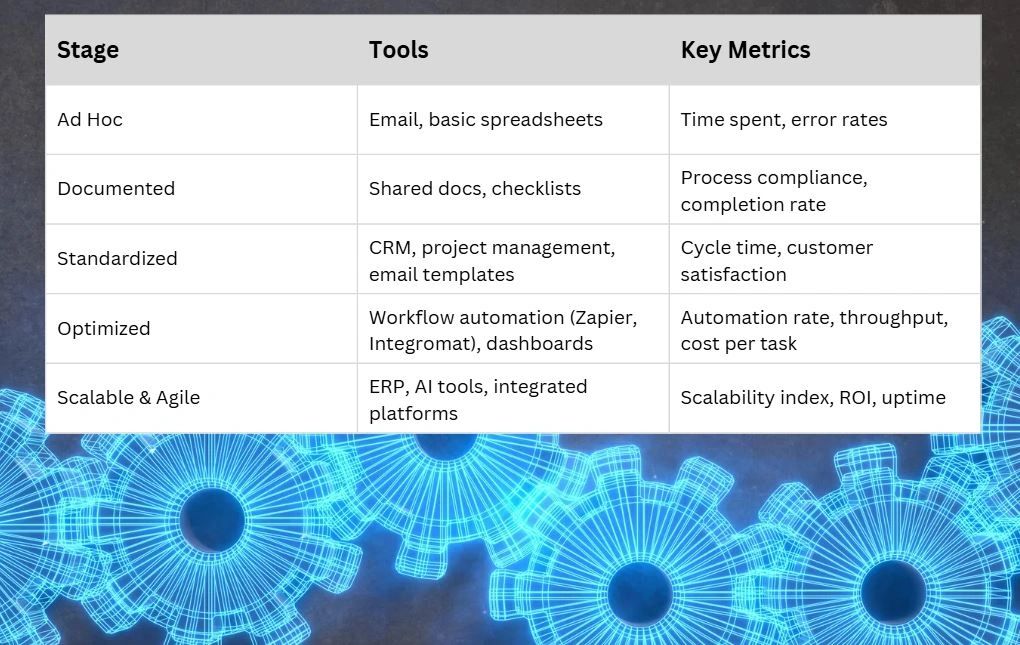
Practical Steps to Build a Scalable Business Process
- Map Your Current Processes Start by documenting your existing workflows, even if they’re informal. Visualize the steps, decisions, and handoffs.
- Identify Bottlenecks and Pain Points Look for repetitive tasks, delays, errors, or unclear ownership.
- Define Standard Operating Procedures (SOPs) Create clear, step-by-step instructions for key processes. Make them accessible to your team.
- Implement Tools to Support Workflows Invest in basic software like CRM, task management, or shared drives to replace manual tracking.
- Introduce Automation Gradually Use automation tools to handle repetitive, rule-based tasks—email sequences, data entry, notifications.
- Measure and Monitor KPIs Track metrics like cycle time, error rates, customer satisfaction, and cost per process.
- Continuously Improve and Adapt Use data and feedback loops to refine processes, add automation, and scale capacity.
Common Challenges and How to Overcome Them
- Resistance to Change: Involve your team early, explain benefits, and provide training.
- Over-Automation: Not every task needs automation, prioritize high-volume, low-complexity processes first.
- Lack of Visibility: Use dashboards and regular reviews to keep everyone informed.
- Siloed Departments: Encourage cross-functional collaboration to ensure smooth handoffs.
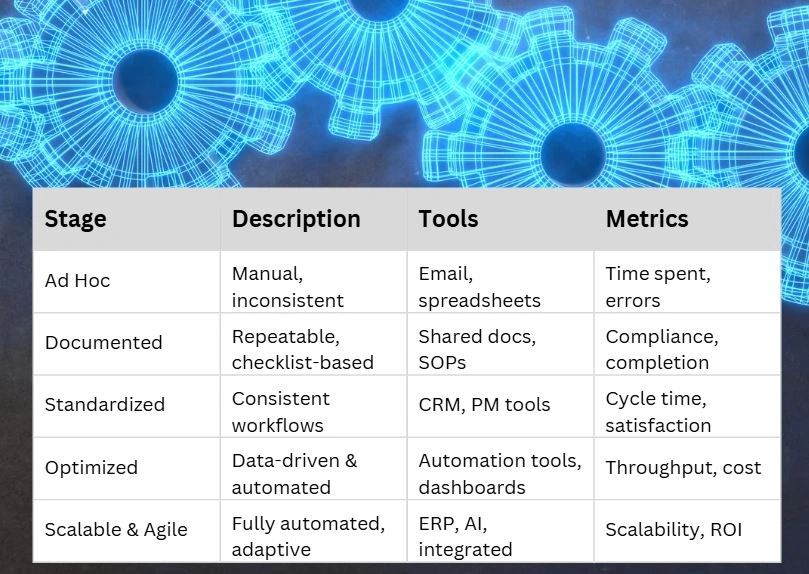
Summary: Your Scalable Process in a Chart
Visualize your process evolution like this:
For startups and small businesses, scalability means preparing your company to grow without chaos so you can focus on serving more customers, innovating, and hitting your next big milestones.
If you want more detailed guidance on process documentation, automation tools, or operational strategy, visit XecuteTheVision.com for resources designed for growing businesses like yours.
Updoot was created to run business operations in one place, start your free trial today and start tracking time, projects, and process.
Frequently Asked Questions
What is a scalable business process? A scalable business process is a sequence of tasks designed to achieve a specific goal that can grow in volume, complexity, or scope without breaking down or requiring exponentially more resources. It is repeatable, efficient, measurable, and adaptable as the business grows.
What are the five stages of business process scalability? The five stages are ad hoc where tasks are done manually with no documentation, documented where processes are written down but still manual, standardized where consistent workflows and basic software tools are in place, optimized where data and automation drive continuous improvement, and scalable and agile where processes are fully automated and adapt rapidly to change.
How do you know which stage your business process is currently at? Look at how work gets done day to day. If tasks depend on individual memory and informal communication you are ad hoc. If you have written SOPs but still do everything manually you are documented. If you use software tools and track metrics consistently you are standardized. If you are using automation and dashboards to drive decisions you are optimized or beyond.
What is the biggest risk of staying at the ad hoc stage too long? Ad hoc processes create bottlenecks when key people are unavailable, make it difficult to onboard new team members quickly, and produce inconsistent results that damage customer experience. Processes that work for 10 customers or 5 projects per month will buckle under the strain of hundreds if they are never designed to scale.
What should a business do first when trying to make processes more scalable? Start by mapping your current processes even if they are informal. Visualize every step, decision, and handoff. Then identify where delays, errors, or unclear ownership occur. Only after you understand how work actually flows should you begin documenting SOPs, implementing tools, or introducing automation.
What is the most common mistake businesses make when scaling their processes? Over-automation is one of the most common mistakes. Not every task needs to be automated and trying to automate poorly defined processes just makes bad processes run faster. Resistance to change from team members is the other major challenge which is best addressed by involving people early, explaining the benefits clearly, and providing proper training before rolling out new systems.