
Take Charge of Vendor & Supplier Relationships with a Scorecard
.png)
Your vision is to deal with vendors who are reliable, reasonable cost, and who deliver on time.
In reality, you will have different experiences with different vendors, making it challenging to determine which to continue working with at times. Ideally, you would be keeping a vendor scorecard for each which will track and manage their performance and effectiveness.
There are a lot of software options and vendor management systems (VMS) out there to assist with this process, such as RFP360 or Smartsheet, but this article will focus on the key components so if you are a smaller business, you can start by trying this without software.
What are the benefits to scoring vendors and suppliers?
- Minimize your risk by knowing exactly which ones rank among the best to work with.
- ID any gaps you may have so you may find redundant or alternative options.
- Stronger negotiation position.
- Transparency among your teams and departments. Each may have a different view of the relationships.
- Using objective data to make decisions and drive performance.
- Agreement from stakeholders in maintaining the relationships.
Who in the business should be using the vendor scorecards?
In larger businesses, this would be the sourcing or procurement team, specifically management, however, if you’re a smaller business, it may be those in general management or an owner.
How do you get started developing the vendor scorecard?
- Brainstorm with your team or yourself and determine the key performance indicators (KPI) or areas you are going to review and measure. Some common high-level examples would be delivery, compliance, cost, quality, and service levels. Additionally, other ideas you may want to think about:
- The company as a whole, other partnerships, financial stability.
- The structure of the organization and ease of contact with your rep, think of response times.
- The level of professionalism.
- Their terms and conditions.
- Ability to understand new requests.
- Ability to meet the requirements.
- Their sustainability.
- Their lead times and how often they are met.
2. Think further about the specific items within the categories or KPIs and what questions will be actionable. Go through your questions to test once complete and think about each answer and score and what you will do with it. If you find yourself questioning what action could be taken, you may want to remove those. Specifically, think in further details like these samples.
- How often are deliveries on time? If they are always on time great, but also think about their communication with you on shipping, tracking and delays.
- How often are deliveries accurate? You may have a plus-minus 5% in place, do they stick to it?
- What is the process when it’s not, how easy is it to remedy or how often does inaccuracy occur?
- What is the quality like? Are you spending a lot of time doing quality checks or are they reliable?
- Who are their other partners and for how long? There is often less risk for you if they have established partners rather than a new-to-market business.
- What priority are you compared to them? If you are 1% of their business, you are unlikely to be treated as a priority when things go south.
- When there is a material shortage, what is that going to mean for you? Again, if you are a small percentage of their business, this could be a higher risk.
- What is communication like when there is a question or delay? If it’s difficult or time-consuming to get a response, they would score lower.
- What are the payment terms? You may prefer a net30 over another offering net15.
3. You need to apply a score to each item. You can choose your scale, but using a 1 to 5 or 1 to 10 is useful as just going with a yes or no might be too black or white. Think about weighing the higher importance items. Weighting and higher importance are often based on how the factors affect the business relationship, your customers, risks, impact on costs as a few examples.
Here’s an example of just looking at delivery for an example, and let’s say delivery is 20% compared to other categories such as cost, etc. We are using a scale of 1 to 10, where 10 is the highest. You want to look at the various components to delivery, their score, and then weigh each one. In this case, being on time is 50% because it’s more important to this sample business than the other items. You can see the delivery weighted score for Vendor 1 is 8. Repeat this for the other high-level KPIs to get a complete score.
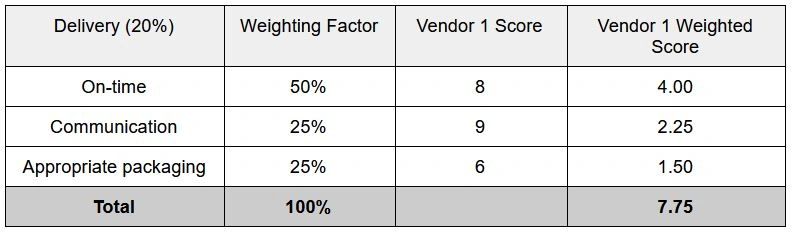
4. It works well if you’re using a spreadsheet for this to list your KPIs down the left side like the above example and across the top, each vendor for easy comparison. You could follow this template and add columns for each vendor.
5. Review your results. You should end up with an analysis of the metrics, a weighting of those by priority, and the areas where improvements are needed. You can then use this information to figure out who your key, most valuable partners are.
Key items to keep in mind during the scorecard development process:
- Communicate with your vendors. You have to remember this is a relationship to be built, and likely planned for long-term so give them insight into your process. This process is a positive when it comes to developing strong strategic supplier relationship management (SRM).
- You likely have several vendors, some of which may include things like office supplies. Depending on your business, that may not be as high of a priority as the vendors supplying materials for manufacturing so keep priority in mind and that not every vendor may need to be involved in this process. Along those lines, you may have vendors who are the only supplier in the market, and in those cases, a scorecard could be useful for communication and making improvements but unfortunately, you won’t have a backup to compare to or switch to.
- Think about the frequency this will be done. It’s somewhat like employee performance reviews where you don’t want to focus on the last two weeks of issues, but instead, the entire term you are reviewing. You may want to keep notes along the way if you are doing this quarterly or every six months.
- Similar to a 360 review of an employee, you will want to speak with others who interact with the vendor, think about those who handle deliveries for example. I’ve experienced vendors who do really well on the sales side, but then when it comes to deliveries, there was failure in providing proper lift gates to get 350-pound machines off trucks, and failure to care for fragile products resulting in a variety of issues and delays.
Learn more about how I can help
References recommended to learn more about vendor and supplier scorecards.
https://rfp360.com/supplier-scorecard/
https://www.smartsheet.com/content/vendor-scorecards
https://www.ppai.org/media/3620/pq_vendor_scorecard.pdf
https://www.logility.com/blog/five-steps-to-launch-a-supplier-scorecard/