
Customer Personas vs Ideal Customer Profile (ICP): Complete Guide
.png)
Learn the difference between a customer persona and an ideal customer profile, when to use each one, and how to build both to sharpen your sales and marketing targeting as a small business owner with our guide below. Most businesses trying to grow their customer base run into the same problem. They know they need to get more specific about who they are targeting but they are not sure whether to build a customer persona, define an ICP, or whether those two things are even different.
They are different. Meaningfully so. And using the wrong one at the wrong stage of your marketing or sales process is one of the most common reasons targeting efforts feel vague, messaging feels generic, and campaigns attract the wrong people even when the execution is solid.
This article explains exactly what each one is, how they work, when to use each, and how the two work together to build a complete picture of your ideal customer.
What Is an Ideal Customer Profile (ICP)?
An Ideal Customer Profile is a description of the type of company or individual who would benefit most from your product or service and provide the greatest value to your business in return. It is a high-level strategic definition of your best customer, focused on the characteristics that make someone a great fit before you ever start thinking about how to communicate with them.
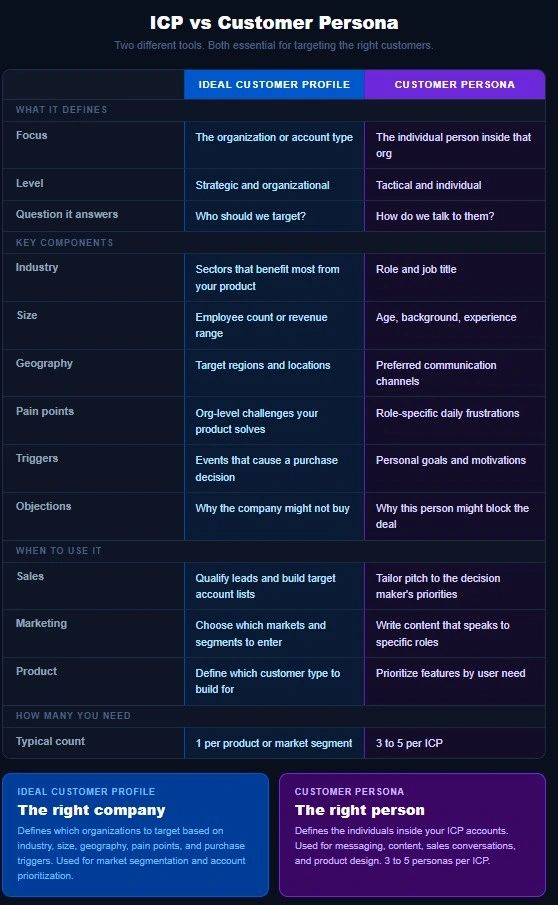
An ICP answers the question: who should we be targeting in the first place?
For a business selling to other businesses, an ICP typically describes the organization itself. For a business selling directly to consumers, an ICP describes the type of person at a demographic and behavioral level.
Key Components of an ICP
Industry: The sectors your best customers operate in. Not every industry you could theoretically sell to, but the ones where your product solves a genuine, urgent problem and where customers see the most value from what you offer.
Company size: Defined by employee count, revenue, or both. A tool built for 10-person teams operates very differently from one built for 500-person enterprises, and conflating the two leads to a product and sales motion that serves neither well.
Geography: The regions where your target customers are located. This matters for sales coverage, compliance, language, and cultural fit, all of which affect whether a potential customer can actually become a successful one.
Pain points: The specific challenges your solution addresses. The more precisely you can name the pain, the more accurately you can identify who is experiencing it.
Purchase triggers: The situations or events that cause someone in your ICP to start looking for a solution right now. A recent data breach, a new compliance requirement, a round of funding, a period of rapid hiring. Triggers tell you when your ICP is in buying mode.
ICP Example
A cybersecurity software company's ICP might look like this:
Industry: Technology and financial services. Company size: 500 to 2,000 employees. Location: North America and Europe. Pain points: Growing threats to sensitive data, difficulty maintaining compliance, limited internal security expertise. Purchase triggers: Recent data breach, new regulatory requirements, upcoming audit, or rapid headcount growth creating new vulnerabilities.
Every sales and marketing decision for this company should filter through that ICP. If an account does not match, it should either be deprioritized or pursued with full awareness that it is outside the target profile.
What Is a Customer Persona?
A customer persona, sometimes called a buyer persona, is a fictionalized representation of the individual decision makers and users within your ICP. Where the ICP focuses on the type of organization, the persona zooms in on the specific people inside that organization who interact with your product, influence the buying decision, or use what you sell every day.
A persona answers the question: once we have identified the right company, who exactly are we talking to and what do they care about?
If your ICP is the address, the persona is the person who answers the door.
Key Components of a Customer Persona
Role and title: Their position in the organization. This determines their priorities, their budget authority, their language, and the problems they are personally accountable for solving.
Demographics and background: Age range, education level, professional history. These inform tone, channel preferences, and the kind of content that builds credibility with them.
Goals and motivations: What they are trying to achieve in their role. Not just what problems they want to solve but what success looks like for them personally. A VP of Sales cares about hitting quota. A CFO cares about cost efficiency and predictability. A front-line manager cares about not getting burned by a tool that makes their day harder.
Challenges: The specific obstacles they face that your product can help with. These are more granular than the ICP pain points because they are tied to a specific role and the pressures that come with it.
Preferred communication channels: Where they spend their attention. Some personas read long-form content. Others live on LinkedIn. Others respond to peer recommendations and customer reviews. Knowing this determines where your marketing budget goes.
Objections: What concerns they are likely to raise about buying. Price, implementation time, executive buy-in, integration complexity. Understanding objections before a sales conversation starts is the difference between a rep who stumbles and one who leads.
Persona Example
For the same cybersecurity company, one customer persona might be:
Name: Security Sarah Role: IT Director Goals: Protecting sensitive company data, maintaining compliance, and demonstrating the value of security investment to executive leadership. Challenges: Managing an increasing threat landscape with a limited budget, translating technical risk into business language for the C-suite, and evaluating security tools without a large dedicated team to run them. Motivations: Doing the job without a breach on her watch. Career protection as much as company protection. Preferred channels: Webinars, technical whitepapers, peer communities, and industry events. Key objections: Implementation time, whether the tool will require dedicated headcount to manage, and whether she can get executive sign-off on the budget.
Notice that Security Sarah exists within the ICP. She is the IT Director at a 500 to 2,000 person technology or financial services company in North America. The ICP got you to the right company. The persona tells you how to actually talk to the person making or influencing the decision.
The Key Differences Between ICP and Customer Personas
The simplest way to understand the difference is this:
Your ICP tells you which companies or customers to pursue. Your personas tell you how to pursue them.
An ICP is strategic and organizational. It is used to decide where to allocate resources, which markets to enter, and which accounts to prioritize. It is the filter your sales team uses to qualify an inbound lead or build a target account list.
A persona is tactical and individual. It is used to write marketing copy, build sales decks, design product features, and train customer success teams. It is the guide your content writer uses when drafting a blog post or your sales rep uses when preparing for a discovery call.
ICPs are used at the top of the funnel to define the universe of possible customers. Personas are used throughout the funnel to guide every piece of communication with the individuals inside that universe.
One more practical difference: a business typically has one ICP per product or market segment. It might have three to five personas within that ICP, each representing a different role, decision-making level, or use case inside the target organization.
When to Use Your ICP
Use your ICP when you are making decisions about where to focus at the organizational level.
When you are deciding which markets or industries to target with your sales and marketing investment, the ICP is your filter. When you are building a target account list for outbound sales, the ICP defines which companies belong on it. When you are evaluating whether an inbound lead is worth pursuing, the ICP tells you whether it fits. When you are deciding whether to expand into a new geography or industry segment, the ICP is the framework for evaluating fit.
Account-based marketing is built almost entirely around the ICP. If your sales motion involves identifying specific companies and going after them with coordinated sales and marketing activity, a precisely defined ICP is not optional. It is the foundation everything else is built on.
When to Use Your Customer Personas
Use your customer personas when you are making decisions about how to communicate with the individuals inside your target accounts.
When you are writing a blog post, you should be writing it for a specific persona. When you are building a sales email sequence, each email should speak to the priorities and language of a specific persona. When you are designing a landing page, the headline should address the persona's most pressing pain point in language they actually use.
Product teams use personas to decide which features to prioritize based on what different user types actually need. Customer success teams use personas to understand what success looks like for different types of users and how to structure onboarding accordingly. Sales teams use personas to anticipate objections, tailor their value proposition, and have conversations that feel relevant rather than generic.
If your marketing content is getting impressions but not clicks, and your sales conversations are not resonating, the most common cause is messaging that was not built for a specific persona. Generic content written for everyone performs for no one.
How ICP and Personas Work Together
ICP and personas are not competing frameworks. They are two levels of the same targeting system, and each one is incomplete without the other.
Your ICP identifies the right companies. Your personas identify the right people inside those companies and tell you how to engage them effectively. Using only an ICP means you know who to target but not how to talk to them. Using only personas without an ICP means you know how to communicate but you are not sure you are communicating to the right audience in the first place.
The practical workflow looks like this. Your ICP tells your sales team to focus on mid-size technology companies in North America with 500 to 2,000 employees experiencing compliance challenges. Your personas then tell your marketing team to create content that speaks to the IT Director's fear of a breach and the CFO's concern about cost predictability. Different messages, different channels, different value propositions, all targeting the same ICP from the angles that matter to each individual role within it.
When ICP and personas are both defined clearly, your entire go-to-market motion sharpens. Sales reps qualify faster. Marketing content converts better. Product prioritization becomes clearer. Customer success becomes more proactive. The investment in defining both pays back across every customer-facing function in the business.
How to Put Your ICP and Personas to Work in Updoot
Defining your ICP and personas is only half the job. The other half is making sure that targeting information actually drives your daily sales and marketing activity rather than sitting in a document nobody reads.
Updoot is built for exactly this. Here is how each part of the platform connects to the work you just did.
Customer Profile Builder
Your ICP and personas live inside Updoot's customer profile module, not in a Google Doc that gets outdated the moment it is created. Every profile is connected to your sales pipeline and CRM activity so your targeting stays current as your market evolves and your understanding of your buyer deepens.
Sales CRM With Lead Tracker
Once you know your ICP, you need a place to track every lead against it. Updoot's sales CRM lets you build a pipeline of target accounts, track every interaction, and see at a glance which leads match your ICP and which do not. No separate CRM subscription. No data living in a spreadsheet that nobody updates.
Competitor Analysis
Your ICP is only as good as your understanding of the alternatives your buyers are considering. Updoot's competitor analysis tool sits alongside your customer profiles so you can track what competitors are targeting, where they are winning, and where the gaps are that your positioning can own.
Sales Quote Creator and Invoice Generator
When an ICP-matched lead is ready to buy, Updoot takes them from proposal to invoice without leaving the platform. The entire sales motion from targeting to close runs in one place.
Goal and KPI Tracking
Once your ICP and personas are defined, the next question is whether your targeting is actually working. Updoot's goal and KPI dashboard lets you set targets for lead volume, conversion rate, and revenue by segment so you can measure whether your ICP is producing the results you expected.
If your ICP is defined but your sales pipeline does not reflect it yet, that is the gap Updoot closes. Sign up free and build your first customer profile today.
Frequently Asked Questions
What is the difference between an ICP and a customer persona?
An ICP defines the type of company or customer who is the best fit for your product at an organizational level. A customer persona defines the individual people inside that organization, their roles, motivations, challenges, and communication preferences. The ICP tells you who to target. The persona tells you how to engage them.
Do I need both an ICP and customer personas?
Yes. They serve different functions and neither one is complete without the other. Your ICP ensures you are targeting the right organizations. Your personas ensure your messaging resonates with the specific people inside those organizations who influence or make buying decisions. Using only one produces a targeting strategy that is either too broad or too disconnected from real buying behavior.
How many customer personas should a business have?
Most businesses need three to five personas. Too few and you are treating different types of buyers as if they are the same person. Too many and your messaging becomes fragmented and your team loses focus. Start with the two or three roles that most commonly appear in your sales conversations and add personas as you gather more data about distinct buyer types.
What is an ICP used for in sales?
In sales, an ICP is used to qualify leads, build target account lists, prioritize outreach, and focus sales resources on the accounts most likely to convert and retain. A well-defined ICP reduces time wasted on accounts that will never be a good fit and increases the percentage of pipeline that converts to closed revenue.
How do you create an Ideal Customer Profile?
Start by analyzing your best existing customers. Look for patterns in industry, company size, geography, and the circumstances that led them to buy. Identify which customers get the most value from your product, have the highest retention rates, and are the easiest to serve. The common characteristics of those customers form the foundation of your ICP. If you are pre-revenue or early stage, use your product's core value proposition to hypothesize the ICP and validate it quickly through outreach and early customer conversations.
What is a buyer persona?
A buyer persona is a fictionalized representation of a specific type of decision maker or influencer in your target market. It includes their job role, goals, challenges, communication preferences, and typical objections. Buyer personas are used to make marketing content, sales conversations, and product design more relevant to the specific people your business is trying to reach.
How often should you update your ICP and personas?
Review your ICP at least annually and whenever you make a significant change to your product, pricing, or target market. Review personas whenever you notice a shift in who is buying, how sales conversations are going, or what objections are coming up repeatedly. The best personas are living documents updated continuously with real data from sales calls, customer interviews, and support interactions rather than static documents created once and forgotten.
Can a small business benefit from building an ICP and customer personas?
Absolutely. Small businesses benefit more from precise targeting than large ones because they have fewer resources to waste on the wrong audiences. A small business with a clearly defined ICP and two or three well-built personas will consistently outperform a larger competitor whose marketing and sales efforts are aimed at everyone. Specificity is the small business advantage, and ICP and personas are how you build that specificity into everything you do
Opens in Google Drive — view and download for free