
Connecteam Pricing vs. Updoot Pricing Explained
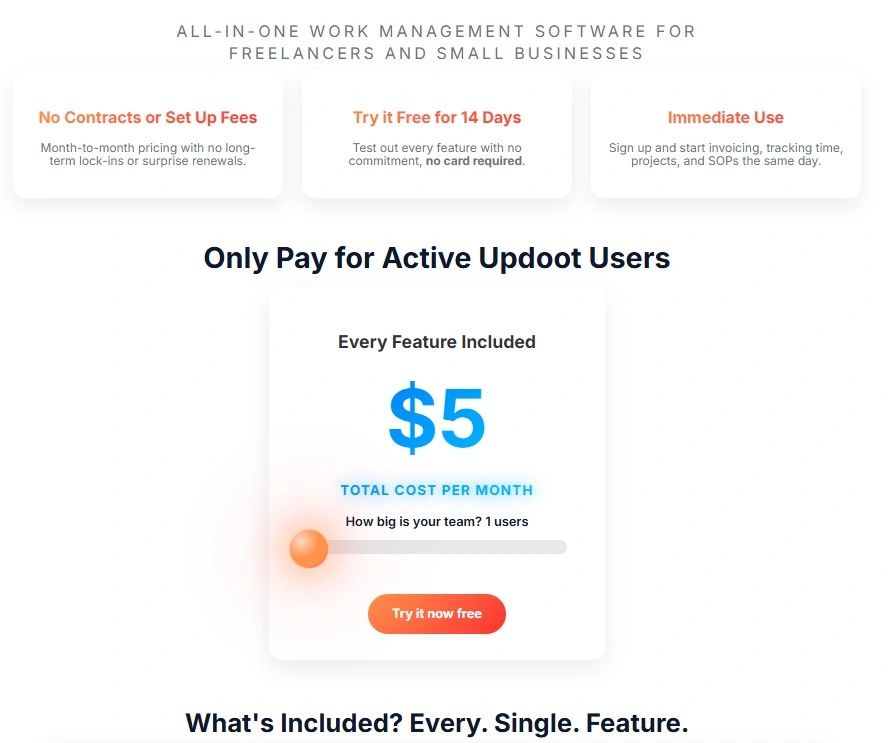
Use our free Connecteam pricing comparison chart to Updoot if you’re searching for workforce management or operations software, as pricing is usually where things get confusing fast. On the surface, platforms like Connecteam look affordable. But once you dig in, you start realizing the pricing structure isn’t as simple as it first appears.
That’s where newer, more streamlined platforms like Updoot are starting to stand out, especially for small to mid-sized businesses that want clarity, not complexity.
In this guide, we’ll break down:
- What Connecteam pricing actually looks like
- How Updoot pricing compares
- Hidden costs most people miss
- Which option makes more sense depending on your business
What Is the Connecteam Pricing Format?
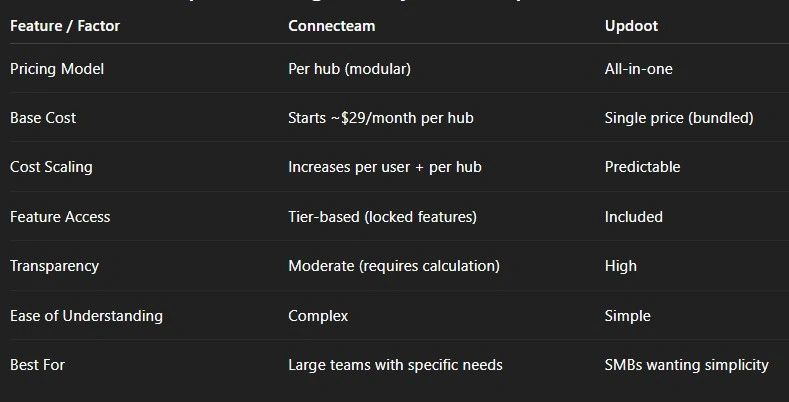
Connecteam uses a modular pricing model, meaning you don’t just pay for one system you pay for different “hubs.”
These include:
- Operations (time tracking, scheduling, tasks)
- Communications (chat, updates, directory)
- HR & Skills (training, onboarding, documents)
Each hub has its own pricing tier.
Connecteam Pricing Breakdown
For each hub, pricing starts at:
- Basic: ~$29/month (up to 30 users)
- Advanced: ~$49/month (up to 30 users)
- Expert: ~$99/month (up to 30 users)
After 30 users, you pay per additional user per month.
They also offer:
- Free plan for up to 10 users
- Limited free plan for small teams
- Enterprise pricing for larger organizations
The Real Cost of Connecteam (What Most People Miss)
Here’s where things get real.
The biggest issue isn’t the base price, it’s how pricing stacks.
1. You Pay Per Hub
If you want:
- Time tracking (Operations)
- Chat (Communications)
- HR tools (HR & Skills)
You’re paying three separate subscriptions.
That means your actual cost could look like:
- $29 + $29 + $29 = $87/month minimum
- Or significantly higher depending on tier
2. Add-Ons Increase Cost Fast
As your team grows:
- Additional users cost extra
- Advanced features require higher tiers
- API and automation are locked behind premium plans
Even though the entry price feels low, scaling gets expensive.
3. Pricing Isn’t Intuitive
Even users themselves point this out.
From real-world feedback:
“The multi-hub pricing model is tough… you have to know exactly what you need before you can figure out the cost.”
That’s a problem, because most business owners don’t fully know what they need until they’re already using the system.
What Is Updoot Pricing?
Unlike Connecteam, Updoot takes a simplified, all-in-one pricing approach.
Instead of charging separately for:
- Time tracking
- PTO
- Projects
- Communication
- SOPs
- Invoicing
- CRM
- HRIS
Updoot bundles everything into one system, and one price per active user.
How Updoot Pricing Works
While pricing may vary depending on setup, the key difference is:
- One platform
- One price
- All features included
No splitting tools across multiple hubs. No guessing what you’ll pay as you grow. Read more about another comparison here to ClockShark.
Connecteam Pricing vs. Updoot Pricing: Side-by-Side Comparison
Which Is More Cost-Effective?
Connecteam Wins If:
- You only need one specific function (like time tracking only)
- You have a very small team (under 10 users)
- You want to customize tools individually
In those cases, the free or low-tier plans can work.
Updoot Wins If:
- You want everything connected in one place
- You’re tired of stitching together tools
- You want to manage multiple teams and departments while growing the business
- You want predictable pricing as you grow
- You care about operational efficiency, not just features
Because here’s the truth most people miss:
You’re not just paying for software, you’re paying for:
- Time spent managing tools
- Errors from disconnected systems
- Team confusion
That cost adds up fast.
The Hidden Cost: Tool Fragmentation
This is where most businesses quietly lose money.
With Connecteam (and similar platforms), you often end up managing:
- Scheduling in one place
- Communication in another
- SOPs somewhere else
- Project tracking separately
Even if it’s all “in one app,” the structure is still fragmented.
That leads to:
- Duplicate data entry
- Inconsistent information
- Extra admin time
And that’s where pricing becomes misleading.
Because a $29/month tool that creates inefficiency can cost more than a $99/month tool that eliminates it.
Why Simplicity Is Winning in 2026
There’s a clear shift happening.
Businesses are moving away from:
- Feature-heavy, complex systems
And toward:
- Simple, unified platforms that actually get used
Because adoption matters more than features.
If your team:
- Doesn’t use the system
- Doesn’t understand it
- Or avoids it
Then even the cheapest tool becomes expensive.
The Bottom Line
Connecteam isn’t a bad platform. It’s powerful, flexible, and works well for certain teams.
But its pricing model:
- Requires calculation
- Grows in layers
- Can become expensive as you scale
Updoot, on the other hand, takes a different approach:
- Simpler pricing
- All-in-one structure
- Built for clarity and execution
And in most small to mid-sized businesses, that simplicity wins.
Final Thoughts
If you’re evaluating tools, don’t just ask:
“What does this cost?”
Ask:
- How much time will this save me?
- How easy is this for my team to actually use?
- Will this scale without getting complicated?
Because the cheapest tool upfront is rarely the cheapest long-term.
Want Simpler Pricing Without the Guesswork?
If you’re looking for a platform that combines:
- Time tracking
- PTO
- Projects
- SOPs
- Team accountability
Into one clean system, Updoot is designed to remove the complexity that tools like Connecteam introduce.
No hub pricing. No stacking costs. Just a system that actually works.